Short answer: to clean a sex doll, wash the body with lukewarm water (around 35 °C / 95 °F) and a fragrance-free, pH-neutral soap, rinse the removable orifice sleeve or flush a fixed cavity with a bulb syringe, pat everything dry with a microfibre towel, let the cavities air-dry completely for two to four hours, then dust TPE skin with renewal powder. A full clean takes 20–30 minutes and should follow every use; a deep clean with a disassembled sleeve is worth doing every four to six weeks.
That is the whole routine in one paragraph. The rest of this guide explains why each step matters, where the two main materials behave differently, and which shortcuts quietly destroy a doll that cost four figures. Everything below reflects how we at MKsexdoll advise customers who have owned the same doll for three years or more — the ones whose skin still looks like it did on arrival.
Why cleaning matters more than any other part of ownership
A sex doll is a large, non-porous-to-semi-porous surface kept at body temperature during use and then stored in the dark. That combination is what microbiologists would politely call a growth opportunity. Bodily fluids, lubricant residue and skin oils left inside a cavity do three things: they feed bacteria, they oxidise and stain the material, and in TPE they slowly migrate into the polymer matrix and cause permanent discolouration.
None of this is dramatic on day one. It is cumulative. The dolls that arrive back at repair shops with yellowed inner thighs and a cavity that smells sour after rinsing are almost never victims of a single catastrophic mistake. They are victims of 200 small ones — a rinse skipped here, a cavity stored damp there, alcohol used just this once to get rid of a mark.
The financial case is blunt. A mid-range doll sits in the $600–$1,600 band we mapped in our 2026 price guide. A disciplined 20-minute routine after each use is, in effect, a maintenance contract on that asset. Skipping it is the single fastest way to turn a three-year product into a one-year product.
Know your material first: silicone and TPE are not interchangeable
Almost every cleaning mistake we see traces back to someone applying silicone advice to a TPE doll, or the reverse. The two materials tolerate completely different things, and the difference is not cosmetic.
Platinum-cure silicone is chemically stable, essentially non-porous, tolerates heat, and can be disinfected with medical-grade agents. It resists staining, does not need powdering, and can be washed more aggressively.
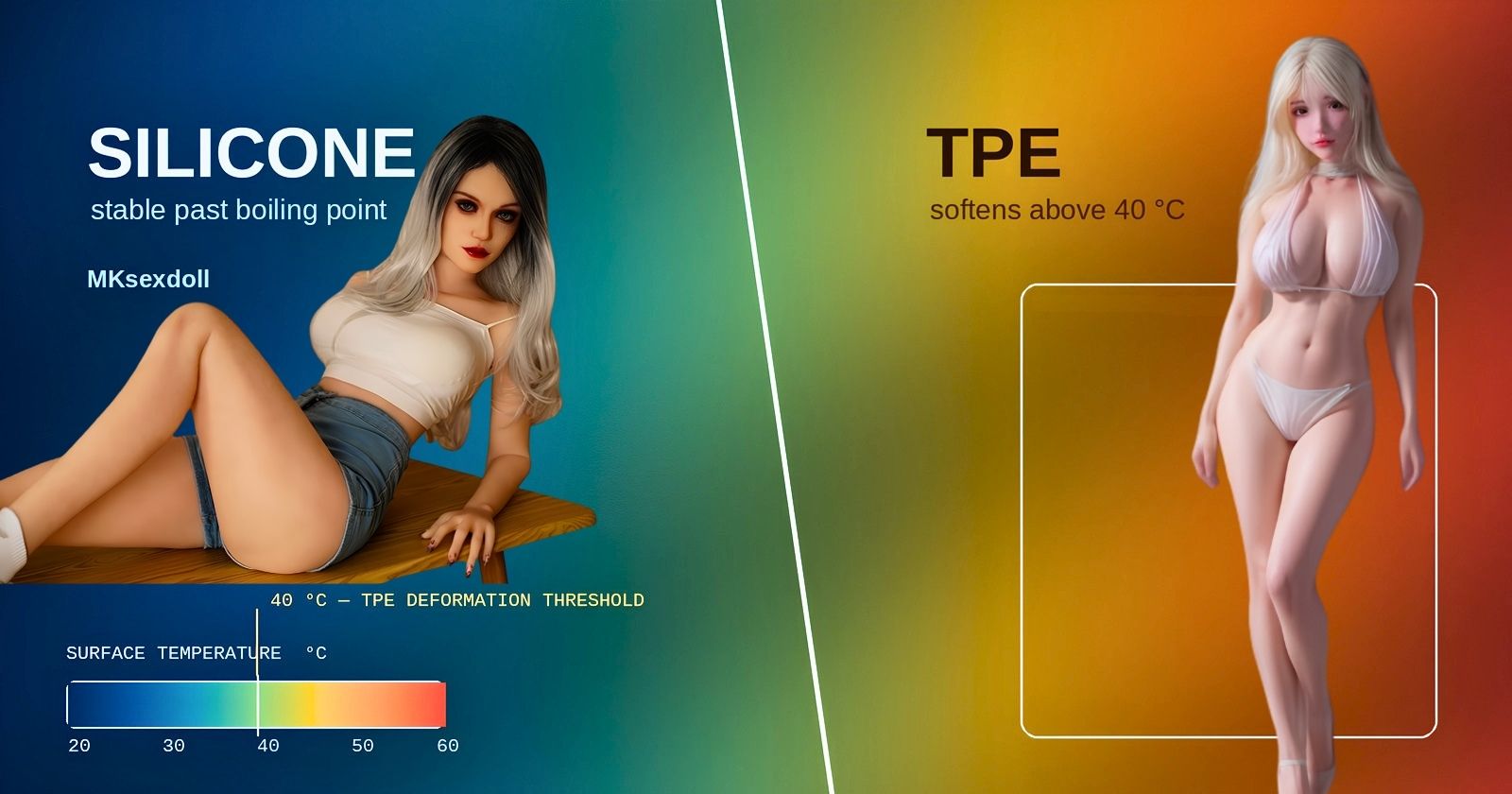
TPE (thermoplastic elastomer) is softer, cheaper, more lifelike to the touch — and porous. It absorbs oils, dyes and moisture. It is damaged by alcohol, by heat above roughly 40 °C, and by prolonged contact with dark fabrics. It needs powdering to stay matte and to stop the surface going tacky.
If you are unsure which you own, the quick test is touch and smell: TPE has a faint oily feel and a mild plastic odour; silicone is drier, slightly squeakier, and almost odourless. We cover the full comparison — density, lifespan, heat tolerance, price — in our complete silicone vs TPE material guide, and you can browse each material directly in the silicone collection or the TPE collection.
| Cleaning factor | Platinum silicone | TPE |
|---|---|---|
| Max safe water temperature | ~60 °C / 140 °F | ~40 °C / 104 °F |
| Isopropyl alcohol | Safe, diluted, spot use | Never — causes cracking |
| Antibacterial soap | Safe | Avoid — use pH-neutral only |
| Renewal powder needed | No | Yes, after every wash |
| Stain resistance | High | Low — dye transfers easily |
| Drying time (cavity) | 1–2 hours | 2–4 hours |
| Oil-based lubricant | Degrades surface | Degrades surface |
| Typical maintained lifespan | 5–10 years | 2–5 years |
The 20-minute after-use routine, step by step
This is the routine that matters. It is short enough to actually do every time, which is the only property that counts.
Step 1 — Remove the sleeve, or prepare the cavity (2 minutes)
If your doll has a removable insert, take it out now. Removable sleeves are the single biggest quality-of-life feature in doll ownership: they turn a 40-minute awkward job into a 10-minute one, and they let the cavity dry properly. If your doll has a fixed cavity, fit a bulb syringe or a dedicated irrigator with lukewarm water and have a towel underneath.
Step 2 — Flush with lukewarm water (3 minutes)
Run 35 °C water through the sleeve or cavity until it runs clear. Do not use hot water on TPE. Heat is the fastest way to deform a TPE cavity, and the damage is not reversible.
Step 3 — Soap, gently (4 minutes)
Use a small amount of fragrance-free, pH-neutral soap — unscented baby wash is the standard recommendation for a reason. Work it with your fingers or a soft sponge. Do not use antibacterial or heavily perfumed soap on TPE; the surfactants and fragrance carriers are exactly the compounds that get absorbed and later cause odour.
Step 4 — Rinse thoroughly (3 minutes)
Residual soap is itself an irritant and a bacterial food source. Rinse longer than feels necessary. For a fixed cavity, flush at least three full syringe volumes of clean water.
Step 5 — Dry the outside (3 minutes)
Pat — never rub — with a clean white or light-coloured microfibre towel. Coloured towels transfer dye into TPE. This is one of the most common and most avoidable staining causes we see.
Step 6 — Dry the inside properly (2–4 hours, passive)
This is the step people skip, and it is the one that causes odour. A removable sleeve should be hung or stood on end to air-dry. A fixed cavity needs either a purpose-made drying stick (a rod wrapped in absorbent microfibre, inserted and left in place) or forced air on a cool setting held at a distance. Never use a hairdryer on hot. Never store a doll with a damp cavity.
Step 7 — Powder TPE skin (3 minutes)
Once the doll is fully dry, dust the body with renewal powder — cornstarch-based, or the powder supplied with the doll — using a large soft makeup brush. This restores the matte, dry-skin feel and stops the surface going tacky. Silicone dolls do not need this step.
Deep cleaning: what to do every four to six weeks
The after-use routine keeps a doll hygienic. The deep clean keeps it looking new. Plan 60–90 minutes.
Start with a full-body wash in a bathtub or on a shower mat, supporting the doll so no joint takes its full weight at an odd angle. Use lukewarm water and the same pH-neutral soap, working in sections. Pay attention to the areas that trap residue and are easy to forget: behind the knees, the underside of the breasts, the gluteal fold, the armpits, and the neck-to-shoulder seam where the head attaches.
Rinse completely, then dry in the same order — pat, never rub. Lay the doll flat on a clean sheet and allow at least an hour of open-air drying before powdering. If your doll has a removable head, detach it and dry the neck connector separately; trapped water at the connector is a common source of both odour and corrosion on the internal skeleton.
Deep-clean day is also inspection day. Run your hands over the full body and look for three things: small surface tears at high-stress points (armpit, groin, finger joints), tackiness that powder no longer fixes, and any discolouration that was not there last month. All three are far cheaper to address early.
Removing stains and preventing them in the first place
Stains on TPE are a dye-migration problem, not a dirt problem. Scrubbing makes them worse. The correct treatment is a stain-removal cream (the mineral-oil based products supplied by most manufacturers) applied thinly, left for the time stated on the packaging — usually 2–12 hours — then wiped off and the area powdered. Expect to repeat it. Deep dye migration can take several treatments across a week.
Prevention is dramatically more effective than treatment:
- Dress the doll in light colours only, or wash new dark clothing several times before it ever touches the body. Cheap black and red fabrics are the primary culprits.
- Never leave clothing on the doll in storage. Weeks of contact under pressure is exactly the condition dye transfer needs.
- Keep the doll off newsprint, dyed leather, and coloured bedding.
- Avoid contact between the doll and other TPE items — plasticiser migration between two TPE surfaces can mark both.
- Use water-based lubricant exclusively. Silicone and oil-based lubricants degrade both materials over time.
What will damage your doll: the definitive do-not list
- Isopropyl alcohol or alcohol wipes on TPE. It strips plasticiser and leaves the surface brittle and micro-cracked. This is irreversible.
- Hot water above ~40 °C on TPE. Softening and deformation, particularly around cavities.
- Hairdryer on a heat setting. Localised melting. Cool air only, held at distance.
- Antibacterial or perfumed soap on TPE. Absorbed, then released as odour.
- Bleach, acetone, hydrogen peroxide, or any solvent. On either material.
- Machine washing a removable sleeve. Hand wash only.
- Storing with a damp cavity. The most common cause of persistent odour.
- Hanging the doll by the neck for long periods without a proper suspension kit — this stretches the shoulder skin over months.
- Silicone lubricant on a silicone doll. Like dissolves like; it degrades the surface.
Storage: the other half of maintenance
How you store a doll between uses does as much damage — or as much good — as how you clean it. The governing principle is that these materials creep: held in one position under load, they slowly take a set.
The best options, in order: a purpose-made hanging kit that suspends the doll by the head bolt inside a wardrobe; a flat-lay position on a soft surface with limbs neutral and a cloth between thighs and between arms and torso; or the shipping flight case, provided the doll is lying flat and not compressed by the lid. Never leave a doll seated for weeks — the buttocks flatten and the hip skin creases permanently.
Keep storage cool, dry and dark. Direct sunlight yellows both materials. Humidity above roughly 60% invites mould in fabric accessories and slows cavity drying. We go through case sizes, hanging hardware, discretion and cost in our dedicated sex doll storage guide.
Cleaning a torso or half-body doll
Torsos are the easiest dolls to maintain and that is a genuine reason to choose one. There is no skeleton to protect, no wig to manage, and the whole unit fits in a sink. The routine is identical but compressed: flush, soap, rinse, pat dry, stand on end to drain, powder. Total time is usually under ten minutes.
The one thing torso owners get wrong is drying orientation. A torso left lying flat traps water in the cavity. Stand it vertically, cavity downward, on a folded towel. If you are still choosing a model, our sex doll torso buying guide covers weight, cavity depth and storage, and the full range is in the torso collection and the Tantaly collection.
Wigs, faces and make-up
Wigs are washed separately, never on the head — water trapped at the neck joint is a problem, and wig dye on the shoulders is a stain. Use cool water and a mild conditioner, comb wet from the ends up, and dry on a wig stand.
Facial make-up on both materials is applied with specialist pigments and is not waterproof. Clean faces with a barely damp cloth and no soap. If make-up does lift, it can be reapplied — most manufacturers sell matching kits — but aggressive face washing will take it off in a single session.
Eyelashes are glued and will come off with water. Keep them dry; reattach with a small amount of lash adhesive when needed.
Special cases: heating systems, robotics and electronics
Dolls with internal heating rods, sound modules or articulated heads add one absolute rule: disconnect and remove every electronic component before any water touches the doll, and never submerge a doll with a non-removable electronic module. Wipe those areas with a damp cloth only.
Heating elements in particular should never be run in a cavity that is still wet. Let the doll dry fully first. If you are weighing up whether the added complexity is worth it, our overview of robotic and AI-equipped dolls and the AI-powered doll buying guide set out what the current generation actually does.
How often should you clean? A realistic schedule
| Task | Frequency | Time |
|---|---|---|
| Cavity or sleeve flush and wash | After every use | 15 min active |
| Cavity air-dry | After every use | 2–4 h passive |
| Body powdering (TPE) | After every wash | 3 min |
| Full-body wash | Every 4–6 weeks | 60–90 min |
| Wig wash | Every 4–8 weeks | 20 min |
| Stain-cream treatment | As needed | 2–12 h passive |
| Joint and seam inspection | Monthly | 10 min |
| Storage position change | Every 2–4 weeks | 5 min |
The kit you actually need (and what to skip)
A complete maintenance kit costs $35–$70 and lasts roughly a year:
- Bulb syringe or irrigator — $8–$15. Essential for fixed cavities.
- Fragrance-free pH-neutral soap — $5–$10.
- Two or three white microfibre towels — $10–$20. Light colours only.
- Renewal powder plus a large soft brush — $10–$18. TPE only.
- Drying sticks — $8–$15. Worth it for fixed cavities.
- Stain-removal cream — $12–$20. Buy before you need it.
- Water-based lubricant — ongoing.
Things marketed to doll owners that you can safely skip: antibacterial doll-sanitiser sprays containing alcohol, UV sterilising wands (no evidence of benefit on these materials and a heat risk), and scented powders. Plain cornstarch-based renewal powder outperforms all of them.
Troubleshooting: five problems and what actually fixes them
The cavity smells even after washing
Almost always incomplete drying. Switch to drying sticks, extend drying to four hours, and do one deep clean with a longer soap contact time. If the doll has a removable sleeve and the smell persists, replace the sleeve — they are consumables.
The skin has gone sticky
Normal for TPE as surface oils migrate. Wash, dry completely, and powder generously. If tackiness returns within days, the doll is being cleaned too infrequently or stored somewhere warm.
There is a small tear at a joint
TPE can be repaired with TPE glue: clean the area, apply sparingly, hold closed for the stated cure time, powder afterwards. Silicone needs a silicone-specific adhesive. Address tears immediately — they propagate under load.
A dark stain has appeared on the hip or thigh
Dye transfer from clothing. Stain cream, repeated. Then change the clothing.
The doll feels heavier to move than it did
Usually retained water in a cavity or in the torso interior. Stand the doll to drain, extend drying, and check that the drain hole (if fitted) is clear.
Does maintenance actually extend lifespan? What the numbers suggest
There is no peer-reviewed literature on doll longevity, and anyone claiming precise figures is guessing. What we can say from warranty and repair patterns across the industry is directional and consistent: dolls returned for material failure inside two years overwhelmingly show evidence of heat damage, alcohol exposure, or chronic damp storage. Dolls still in good condition at five years almost always belong to owners with a fixed routine.
The honest framing is that cleaning does not add magic years. It removes the causes that subtract them. A TPE doll has a realistic 2–5 year window and maintenance decides where in that range you land; silicone has a 5–10 year window and the same logic applies.
Where to go next
If you are still choosing a doll, material is the decision that determines your entire maintenance burden — start with the silicone vs TPE guide, then the price guide. If you want the lowest-maintenance entry point, a torso is the honest answer. If you want a full-size doll, browse by build in the curvy, Asian, Japanese and male doll collections, or by maker in the WM, Irontech and Starpery collections. For a build made to your own specification, see the custom doll guide.
Frequently asked questions
How do you clean a sex doll after every use?
Remove the sleeve or flush the fixed cavity with lukewarm water at about 35 °C, wash with fragrance-free pH-neutral soap, rinse until the water runs clear, pat dry with a white microfibre towel, air-dry the cavity for two to four hours, and powder TPE skin once fully dry. Active time is 15–20 minutes.
Can I use alcohol or antibacterial soap to clean a sex doll?
Not on TPE. Isopropyl alcohol strips plasticiser and causes permanent micro-cracking, and antibacterial or perfumed soaps are absorbed by the porous surface and later cause odour. Platinum silicone tolerates diluted alcohol for spot disinfection, but plain pH-neutral soap and water is sufficient for both materials.
How do you clean a TPE sex doll differently from a silicone one?
TPE needs cooler water (under 40 °C), pH-neutral soap only, longer drying, and powdering after every wash. Silicone tolerates hotter water, can be disinfected more aggressively, never needs powder, and resists staining. Applying silicone methods to TPE is the most common cause of avoidable damage.
How do you get the smell out of a sex doll?
Odour is nearly always trapped moisture rather than trapped dirt. Do one deep clean with extended soap contact, rinse thoroughly, then dry the cavity for a full four hours using drying sticks or cool forced air. Store only when completely dry. If a removable sleeve still smells afterwards, replace it.
How do you remove stains from a TPE sex doll?
Use a mineral-oil based stain-removal cream, applied thinly and left for two to twelve hours, then wiped off and powdered. Repeat over several days for deep dye migration. Do not scrub, and do not use solvents. Prevent recurrence by keeping the doll in light-coloured clothing and never storing it dressed.
How should a sex doll be stored between uses?
Hanging by the head bolt inside a wardrobe is best, flat-lay on a soft surface with neutral limb positions is second best, and the shipping case is fine if the doll lies flat and uncompressed. Keep it cool, dry, dark and undressed. Avoid seated storage entirely — it permanently creases the hips.
How often does a sex doll need a full deep clean?
Every four to six weeks for a full-body wash, alongside the after-use cavity routine. Owners who use the doll several times a week should treat four weeks as the maximum interval.
What cleaning supplies do I actually need?
A bulb syringe, fragrance-free pH-neutral soap, two or three white microfibre towels, renewal powder with a soft brush (TPE only), drying sticks, stain-removal cream and water-based lubricant. The whole kit costs $35–$70 and lasts about a year.
Can cleaning damage the doll face or make-up?
Yes. Facial pigment is not waterproof. Clean faces with a barely damp cloth and no soap, keep eyelashes dry, and wash wigs separately on a stand rather than on the head.
Does cleaning really extend how long a doll lasts?
It removes the main causes of early failure — heat damage, alcohol exposure and damp storage. A maintained TPE doll realistically lasts 2–5 years and a maintained silicone doll 5–10; neglected dolls fail at the bottom of those ranges or below.